
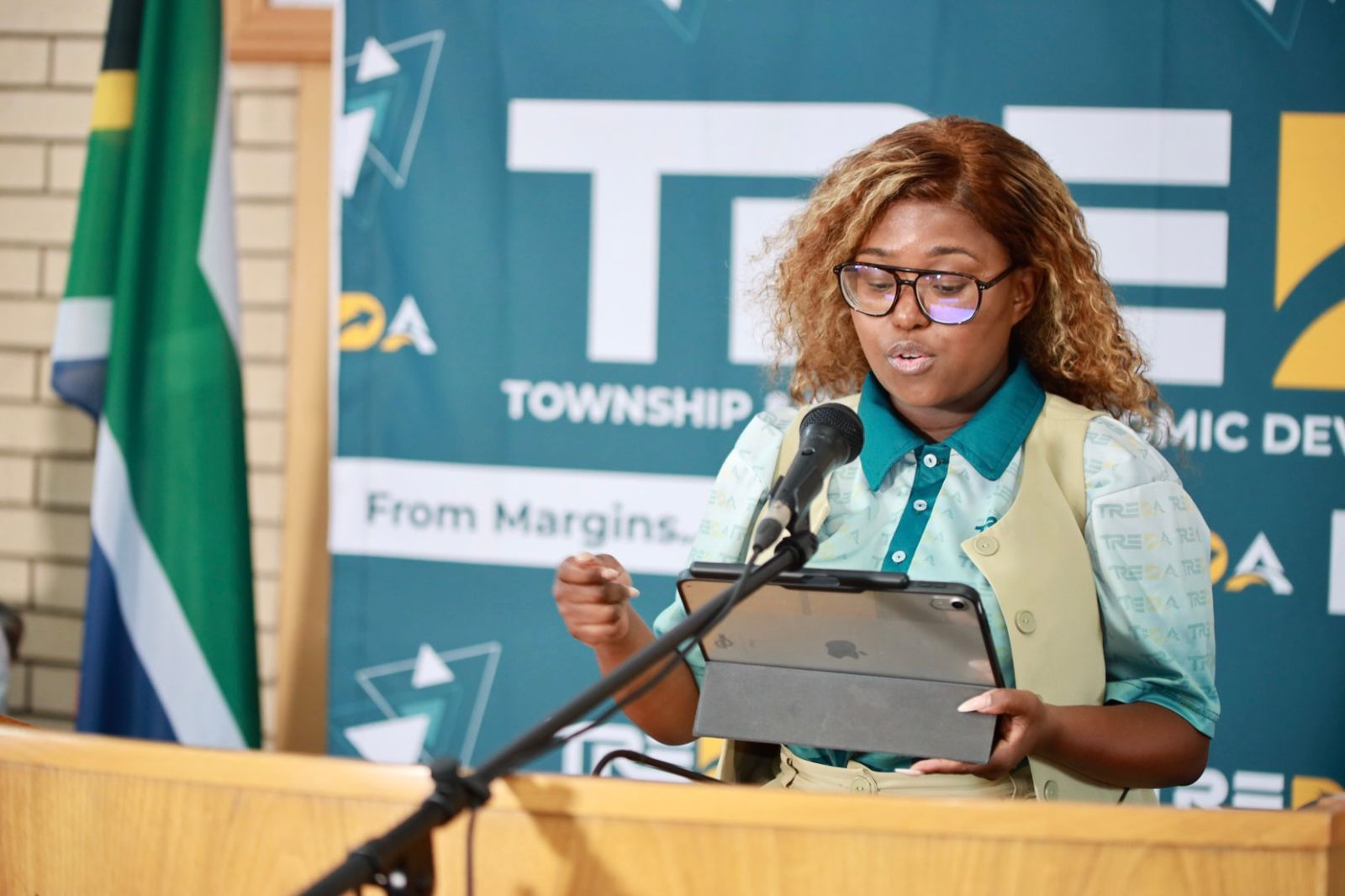
TREDA 2026 Q1 SECTORAL ADDRESS
Speaker: Ms Qhamisa Tengile – TREDA CEO Theme: From Margins to Merit: The Economy South Africa Can No Longer Ignore
Greetings are in order, to:
- TREDA Advisory Board Chair
- TREDA Executive team
- Small, Micro & Medium Enterprises
- Informal traders
- Street Hawkers
- Development partners
- Government departments
- Broader township and rural economy ecosystem.
South Africa’s township and rural economy does not exist in boardrooms. It lives in our streets, townships, villages, informal markets, backyards, spaza shops, farms, workshops, and trading hubs. It is where millions wake up every day to create value without protection, trade without access, and build businesses without systems. This is the economy that feeds households, employs neighbours, absorbs youth, and keeps communities alive – yet it remains undervalued, under-financed, informalised, and largely invisible.
TREDA exists because the township and rural economy can no longer wait to be rescued. It must be organised, activated, and scaled.
The reality within the sector
Across South Africa, over 70% of township and rural enterprises operate informally, and access to finance remains below 10% for small and micro businesses. Markets are fragmented, compliance is complex, and infrastructure is uneven. SMMEs trade in isolation, without data, visibility, or negotiating power, while policy is often designed about SMMEs, not with them. Yet, despite these challenges, townships and rural areas drive daily consumption, host labor-intensive industries, and are central to food security, youth employment, local manufacturing, and services.
The problem is not a lack of effort; it is a lack of structure, coordination, and an ecosystem that works for the SMME, not around them.
We have all been told to separate business money from personal money, but let us be honest; what happens when:
- You get home and there is no food in the house?
- Your child needs school shoes?
- Your family depends on you today, not next quarter?
In townships and rural areas, business and survival are deeply connected. Ignoring that reality is why so many interventions fail. This is how businesses get trapped in a hand-to-mouth cycle: You make money today, it solves an urgent family need, the business cannot grow, and tomorrow you start again from zero.
That is not a lack of discipline – it is a lack of realistic solutions. TREDA exists to redesign the system.
TREDA is not another organisation competing for space. TREDA is an activation agency built to unlock the real economy where South Africans live, trade, and create. We activate informal productivity into structured enterprise. We accelerate inclusive growth through systems, infrastructure, finance, and technology. We ascend communities from participation to ownership, from survival to sustainability. TREDA is the bridge between policy, intention, and implementation.
TREDA 2026 Priorities | The Architecture of Growth
In 2026, TREDA focuses on fifteen priority areas anchored in three outcomes:
- Visibility and national reach
- Formalisation, compliance, and risk mitigation
- Sustainable market access and finance.
This includes data and database collection, digital and physical infrastructure, skills and entrepreneurial education, financial support and resource mobilisation, manufacturing, agriculture, oceans economy, tourism and arts, as well as research, mapping, and policy engagement. This is not scattered work; it is deliberate local economic engineering.
2026 Quarter One | Program Of Action
Quarter One is about presence, reach, and proof. In 2026 Q1, TREDA will:
- Establish and strengthen provincial chapters.
- Adopt one township school and one rural school to seed entrepreneurship in the basic education system.
- Launch a physical Township & Rural SMME Incubation Centre.
- Rollout a digital SMME One-Stop-Shop informed by mass stakeholder engagement.
- Officially open a TREDA office to make the agency physically reachable to SMMEs.
- Embark on roadshows, affiliate engagements, and stakeholder coordination forums.
This is where strategy becomes visible work.
Pre-SONA Sectoral Mandate & Expectations
This Sectoral Address precedes the State of the Nation Address (SONA) to be rendered by the RSA Head of State; His Excellency, President Cyril Ramaphosa. The township and rural economy shifts from reactive to proactive. TREDA places before the President and the State a sectoral mandate:
- SMME-centred policy
- Infrastructure that reaches where people trade,
- Procurement that includes township suppliers,
- Financing models that understand micro-enterprise realities
- Data-driven planning rooted in lived economic activity.
This is not opposition; this is partnership and development with clarity.
TREDA SMME Affiliation | The decider between stagnation and growth
Growth does not happen in isolation. SMMEs that remain disconnected from data, markets, mentorship, and systems will struggle to scale. TREDA Affiliation is access to visibility, to coordinated support, to markets and partnerships, and to influence and representation. Affiliation is how small businesses stop knocking individually and start moving collectively.
Through TREDA, SMMEs gain market visibility, support with compliance and formalisation, access to mentorship and advisory services, pathways to finance and procurement, inclusion in policy conversations, and a platform that speaks with them, not for them.
How stakeholders can participate
TREDA invites government to create an enabling environment, the private sector to invest with impact, development partners to scale proven work, academia and researchers to ground policy in data and lived experience, and media to amplify the real economy. TREDA is a platform for collaboration, not competition.
The National Dialogue of South Africa
As part of this Sectoral Address, TREDA calls on SMMEs to actively participate in the National Dialogue of South Africa — a principled process aimed at shaping a People’s Compact that defines a renewed agreement between the state and its citizens. Through your participation, SMMEs do not only speak into national priorities, but directly influence the development of SMME-friendly policies that reflect real economic conditions on the ground and secure a more inclusive, responsive economy.
In Conclusion.
The township and rural economy is not a side conversation. It is South Africa’s economic heartbeat. In 2026, this economy becomes visible, structured, investable, and governed with dignity. TREDA is not here to promise miracles; we are here to build systems that last. If you trade in the township, if you produce in rural South Africa, if you believe growth must include everyone, TREDA is where the future of the real economy is being organised. This is not an invitation to watch – it is a call to belong, participate, and build.
“Always bear in mind that the people are not fighting for ideas, for the things in anyone’s head. They are fighting to win material benefits, to live better and in peace, to see their lives go forward, to guarantee the future of their children.” ~ Amilcar Cabral
