
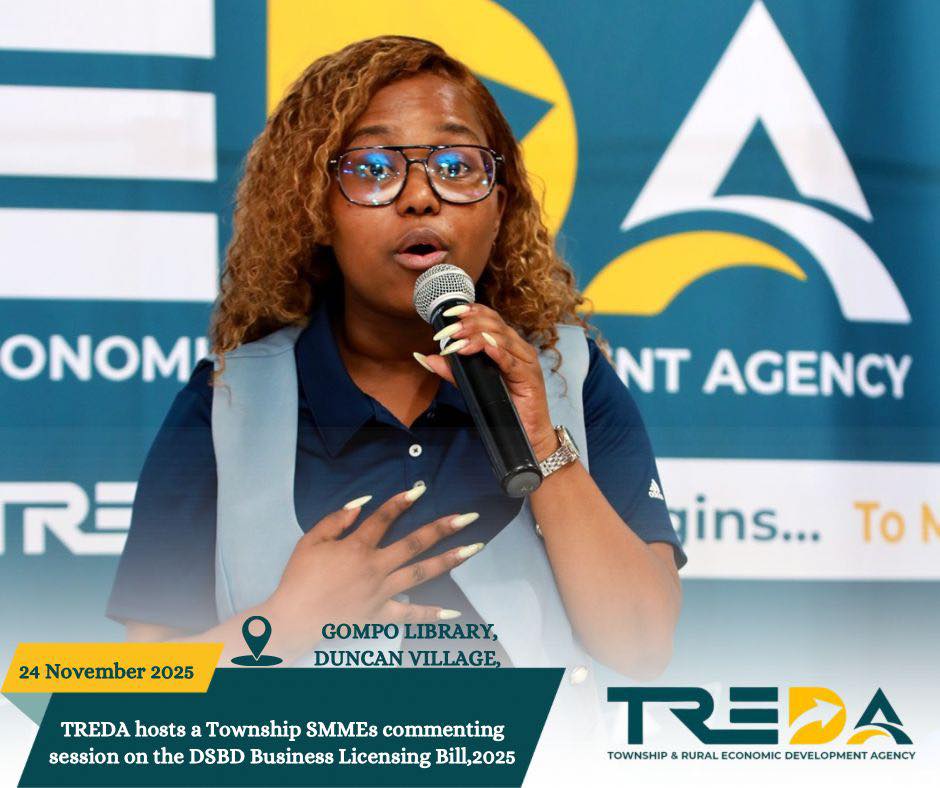
Duncan Village, Eastern Cape – The quiet setting of the Gompo Library in Duncan Village was transformed into a powerhouse of economic discourse as the Township Economy Development Association (TREDA) convened over 150 local entrepreneurs to dissect and take ownership of the proposed Business Licensing Bill, 2025.
Dubbed “DAY 1 – TREDA TAKES THE FLOOR 🔥,” the gathering was far from a conventional dialogue; it was the grassroots economy taking ownership of policy, marking a critical moment in the fight for Economic Justice and amplifying SMME Voices. The message from the entrepreneurs was described as “loud, and uncompromising,” signaling the township economy’s refusal to remain on the margins of legislative processes that directly impact their livelihoods.
Key Shifts Under the Proposed Bill
The session’s focus was to unpack the specifics of the Business Licensing Bill, 2025, a piece of legislation aimed at replacing the outdated Businesses Act of 1991. The entrepreneurs honed in on two major proposed changes that promise to streamline and standardize business operations:
- ✔️ Faster Approvals through a Digital Licensing System: The Bill introduces a digital, modern system designed to expedite the application and approval process for business licenses. This move is anticipated to significantly reduce the bureaucratic red tape that often suffocates emerging businesses and informal traders.
- ✔️ One Standardised Process Across All Municipalities: Currently, varying by-laws across different municipalities create a confusing and costly compliance nightmare. The Bill aims to establish a national, uniform licensing framework, promoting greater consistency and coherence across the country.
TREDA’s Stance: Support with a Mandate for Inclusion
While the Bill has drawn mixed reactions from various business sectors, TREDA made its position unequivocally clear: “We support the Bill.”
However, this support is conditional and comes with a strong mandate for proactive amendments. The organisation emphasized that its recommendations are specifically engineered to:
- Strengthen Inclusion: Ensuring the new system is accessible and sensitive to the unique realities and infrastructure challenges faced by businesses operating in townships and informal settlements.
- Simplify Compliance: Translating the digital and uniform framework into processes that are genuinely simple and affordable for small and micro-enterprises.
- Keep Entrepreneurs Inside the Economy, Not Outside the Law: Advocating for a regulatory environment that incentivizes formalisation rather than imposing prohibitive barriers that push vital economic activity further into the informal sector.
This perspective aligns with the Bill’s stated principle of “redress,” which mandates that licensing policies must actively correct historical inequities by improving access and ensuring the inclusion of previously excluded communities.
“From Margins to Merit”
The power of the meeting, according to the organizers, lay in its format: it was not a passive consultation but an active process where local entrepreneurs articulated their needs directly into the policy conversation. The slogan “From Margins to Merit” captures the essence of this movement, asserting that the township economy—estimated to be worth hundreds of billions annually—must be recognised and supported based on its economic value and potential, not just its location.
The unified voice from Duncan Village serves as a powerful reminder that effective policy cannot be crafted in a vacuum. The input from TREDA and the 150+ entrepreneurs will be crucial in shaping the final version of the Business Licensing Bill, 2025, ensuring it truly serves as an instrument of economic empowerment and justice, and not another administrative hurdle.
